Vehicle Fault Prediction & Anomaly Detection using Autoencoders
Project Overview:
This project explores a methodology for analyzing OBD-II data to predict critical vehicle parameters affecting performance and reliability. Using artificial intelligence and machine learning, the system automates fault diagnosis and anomaly detection through an Autoencoder neural network.
• Dataset & Preprocessing
- Selected 8 vehicle sensors from OBD-II data
- Preprocessed and normalized data using MATLAB for Autoencoder input
- Dataset prepared to highlight meaningful patterns while reducing noise
• Model Architecture & Training
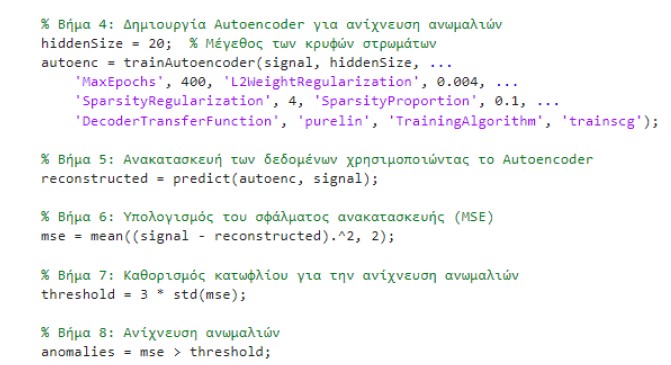
- Autoencoder with 20 neurons in the hidden layer
- Regularization techniques:
- L2 to prevent overfitting
- Sparsity regularization to focus on key features
- Sparsity proportion to control active neurons in the hidden layer
- Decoder transfer function:
purelin for reconstructing continuous values
- Training algorithm:
trainscg (scaled conjugate gradient)
- Training epochs: 400 to learn normal data distribution
• Anomaly Detection
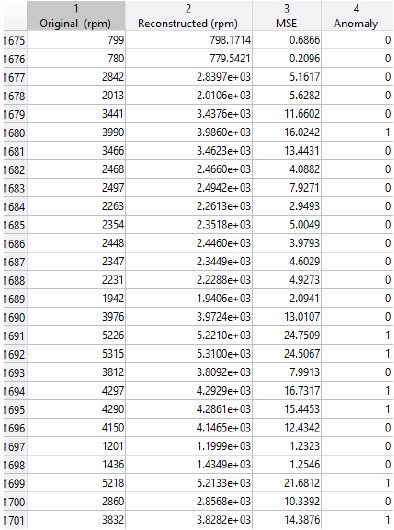
- Reconstructed sensor data using the trained autoencoder
- Calculated reconstruction error (MSE)
- Defined anomaly threshold based on MSE
- Compared original and reconstructed data
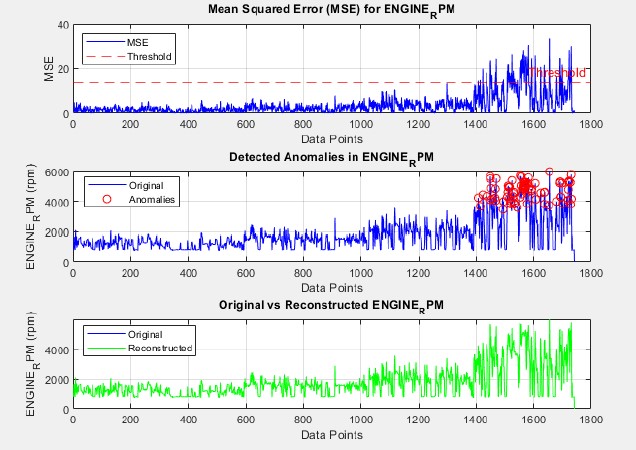
- Visualized results through plots showing:
- MSE distribution
- Detected anomalies
- Original vs reconstructed data
• Key Highlights
- Successfully detected deviations in sensor readings
- Related anomalies to OBD-II fault codes and sensor specifications
- Methodology can be extended to other OBD-II parameters, enhancing predictive maintenance capabilities
• Technologies & Tools
- MATLAB for preprocessing, training, and analysis
- Autoencoder Neural Networks
- Data visualization and evaluation techniques for fault prediction
• How to Use
- Open MATLAB project
- Load OBD-II dataset: exp3_4drivers_1car_1routeNEW.csv
- Run training scripts to train the autoencoder
- Apply reconstruction to detect anomalies
- Review MSE plots and anomaly reports
• Results